
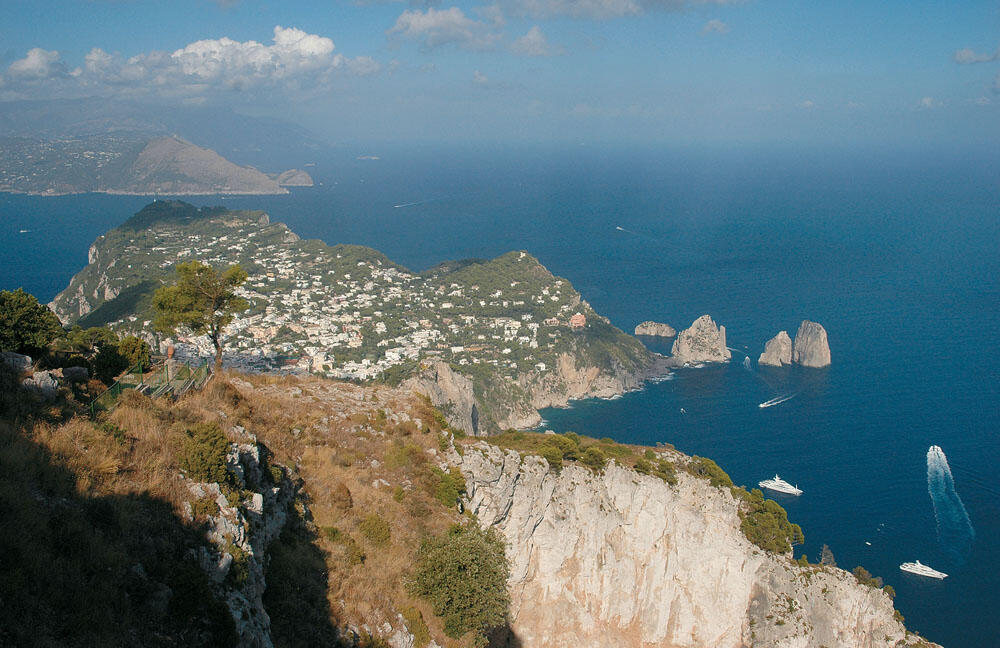
The island of Capri

The Strait of Messina and Tropea
The island of Capri
The Strait of Messina and Tropea

Wandering around the famous Costiera Amalfitana
Filled with the unexpected wonderful pictures Tropea has offered to us, we were preparing to sail for another mythic sea, the "sea of sirens". We filled our tank with fuels in Tropea’s marina and our bow was targeting at the end of the southern peninsula of the Bay of Naples.

Our compass bore 325° and the distance we had to cover was 134 nautical miles. A 3rd person found us on our left mask and we felt very lucky, since this part we had to go through was not one of the easiest. Even with winds of 5 Beaufort we would have had enough difficulty, since in this area the winds come from the north-west and so we would go the whole way with the weather on our left mask or offshore.
So we were traveling comfortably at 26 knots, with the engine working at 4250 rpm, while our consumption did not exceed 42 liters per hour. All we had to do was enjoy our beautiful sailing.
Although I never ride sitting down, the Shearwater predisposed me to do so. So I sat in the driver's seat and started checking everything around me. The first impression I got was that I had an excellent view both of the sea and of the instrument panel, the inclination of which is such that all the indications are readable without having to get up every now and then. Visibility to the compass reading, tachometer and speedometer was immediate. On the other hand, the low cabin frontage and the cleverly designed windshield completely blocked the airflow, so we could talk to each other in low voices without the need to shout to be heard. So, our hours flowed nicely, making our next plans.
We were approaching two of the most famous travel destinations of the Mediterranean and the entire world. On the famous Costiera Amalfitana, located on the southern side of the Sorrento peninsula, and on the cosmopolitan island of Capri, located a few miles to the west.
Our impatience was indescribable when, shortly before sunset, to the left of our bow, the famous Capri was now clearly visible, while in front and to our right stretched the promising peninsula of Sorrento. We quickly arrived under the lighthouse of Punta Campanella, the headland of the peninsula.

We intended to make a quick, more exploratory, voyage, in order to arrive at a point which we would use as a base for the days of our stay here. We wanted to find a quiet place to spend the night, which would be roughly between Capri and Amalfi (also known as Costiera Amalfitana), being almost certain that there would be no free space in the marinas of both, which are the only ones in the area to tie, apart from the fact that these marinas are also very expensive. In an hour it would be dark and our time was very limited.
At marina del Cantone
We finally ended up at marina del Cantone. Of course, there is no marina here, since the Italians by the term "marina" simply mean the beach. The marina del Cantone is therefore the stairway to the village of Nerano, a small village located a little above the beach, tucked into the dense vegetation. A fishing village that enjoys its peace between the busy Capri and Amalfi. Its name comes from the emperor Tiberio Nerano who lived for very long periods of time in neighboring Capri. So he once visited the Cantone "marina" and, enchanted by its beauty, decided to build another villa in this area.
It is worth noting that the Cantone coast was a famous carnage for the ancient Greeks, the Romans and also for many pirates.
marina del Cantone is located 1.5 nautical miles east of Punta Campanella. To its west is the deep Jeranto Cove and to its east is Recommone Cove. It is a beautiful pebbly coast, which is 4.5 miles from Capri which is further west, and 6 nautical miles from Positano and Amalfi which are further east.
From the eastern end of the marina del Cantone a path starts that goes east and after 10 minutes of panoramic drive it takes us to Recommone cove, where there is a very nice stone restaurant on the rocks of the coast. It is one of the most famous of the region and is visited by many people, mainly from the sea.
If we are in the mood for walking, we can take the uphill path that starts at the western end of the marina del Cantone and reach high up on the hill where the steep vertical cliffs that surround Jeranto Cove are breathtaking. From here, the view towards Capri is magnificent. Jeranto's name comes from the Greek word Ierax (Hawk), because the ends of the peninsula that hug the bay look like hawk claws.
Marina del Cantone is an open and large bay facing south. The waters here are very deep, that is why many remenzas have been placed in parallel rows, which are full of boats. Visitors' boats are also moored at the remezzas, which are transported to the coast in the small boats of the locals who take advantage of these remezzas. This is also the only way one can get to land, which is common throughout the wider region.

Towards the eastern side of the marina del Cantone there is an iron wharf, which is permanently free and has the role of a "bridge" for disembarkation and embarkation of those approaching with their own boats.
From this "bridge" depart the tourist boats that make day trips to neighboring Capri and Costiera Amalfitana. This pier is also the liveliest part of the beach, since there is traffic throughout the day.
On the beach there are two very famous floating restaurants, known for their local cuisine and wonderful seafood dishes: The Maria Grazia restaurant, located at the eastern end of the coast, and the Da Tomaso al lo Scoglio restaurant, located at the about the middle of the beach. Both very beautiful, they have been extended with wooden lofts into the sea, even having their own space to tie up. But not everyone is allowed to tie there. Seats are limited and reserved for yacht tenders arriving from Capri. The rest of the boats, as happened with us, moor at the remezas located a few tens of meters from the restaurants, and from there the people of the restaurants take over, with their own boats, to transport the people to the floating lofts.
The gray pebbly beach, between the two floating restaurants, is lined with umbrellas and sunbeds. There are several shops that serve pizza, coffee and food, while many people enjoy their bath until late at night.

Certainly, marina del Cantone is not the place that will excite you at first sight. But beyond the fact that it is a strategic overnight stop, it is a very nice place, embraced by the green hills that descend smoothly to the sea. Unadulterated and genuine, it promises us very sweet and quiet evenings, away from the crowd and bustle of the neighboring busy areas.
I would say that it is a place that shows us a more real and authentic image of the Italian countryside, while giving us the opportunity and time to get in touch with the very nice and permanently smiling locals.
Such a wonderful man, whose face and smile showed an incredible kindness, was also Nino, whom we met the night we took our walk on the iron pier. So Nino, with an excess of enthusiasm and great joy, gave us all the information we needed and generally made us feel like we had found our own person in these faraway places.
Owner and captain himself, of one of the excursion boats that leave every morning at nine o'clock from the shore, he was the ideal person to inform us about the attractions of the surrounding area. First of all, we asked him to inform us about the weather prevailing in the wider area in the month of August, so that we can plan our visits accordingly. And here's what he told us:
"The weather in general in the summer is very good and very rarely exceeds 4 Beaufort. After noon it produces a light storm, which falls in the late afternoon. In the evening there is always a light breeze from the east, which slowly turns to the south to finally end up in the southwest. This cycle repeats every 24 hours. If this breeze does not blow in the evening and there is apnea, then we expect bad weather the next day. Very rarely, however, the sea exceeds 5 Beaufort".
Nino was the one who urged us to tie up a little further, under the reeds where the village campsite is located. That is where we ended up every night after our daily wanderings. A beautiful and mostly quiet spot, ideal for an overnight stay.
In the "Sea of Sirens"
The next day we headed east, sailing coast to coast, intending to explore bit by bit the famous Amalfi Coast, also known as Costiera Amalfitana, which stretches from Positano in the west, to Vietri in the east. The main resort of the coast is Amalfi, which together with Positano and the mountainous Ravello are the main attractions of the Costiera Amalfitana.
Until the 19th century the entire coastline constituted the barren line of southern Italy and access was only possible by mules up the difficult mountain paths. At the beginning of the 20th century, this isolation began to attract many travelers who were looking for something different. Thus, people of art and spirit, as well as famous personalities, began to arrive. The beauty of the coastline is so breathtaking that it has been the source of inspiration for many years for a long list of distinguished people such as Nietzsche, Ibsen, Goethe and Wagner.
Today, the Costiera Amalfitana is a paradise on earth that attracts millions of visitors from all over the world every year, who flock to this unique coastline to enjoy the unique views at the edge of the cliffs, enjoy their espresso in the lovely little squares and admire the unique architecture of the elegant seaside villages. Without a doubt, the Amalfi Coast is a special travel destination, rightly called the "Saint Tropez of the Italian South".

I could compare it to our own Aegean, Pelionian coastline. The two coastlines have many similarities and are of course equally spectacular. The Costiera Amalfitana excels in opulence and beauty in terms of the main seaside resorts, while our own Pelion clearly excels in terms of its exotic beaches, lush vegetation and of course the most brilliant sunlight, which characterizes the entire Aegean. Costiera Amalfitana, however, receives multiple visitors every year, since it has managed to become one of the most popular destinations in the entire world.
So we started in the morning from marina del Cantone. After the cove of Recommone we passed close by the islet of Isca and arrived in front of an impressive deep gorge, at the end of which a very small beach is formed, the marina di Crapola. Inside the narrow gorge are some ruined houses. A small temple dedicated to Apollo was also built here by the ancient Greeks, from which the name of the small coast comes.
We continued along the coast for a while and the sight became more and more exciting, with the high mountain masses falling steeply into the sea. At one point, directly opposite the coast and at a distance of less than two nautical miles, the Li Galli islets were clearly visible. Known since ancient times as the "land of the Sirens", there was no chance not to visit them. Our bow turned that way and soon we were in this mythical land.
The Li Galli islets
It is a small cluster of three islets, which are a few tens of meters apart. They are located 3.5 miles southeast of marina del Cantone and 3.5 miles southwest of Positano. The largest islet is called Gallo Lungo, while next to it are the smaller ones Castelluccia and Rotonda.
In Gallo Lungo there are some remains of the Roman era but also two large buildings built in 1930 by the Russian choreographer and musician L. Massine. The island was later bought by another Russian, the famous Rudolf Nureyev. These three islets are today a protected area and belong to the wider marine park of Punta Campanella.
According to many scholars, these islets are the Sirinous Islands, where the Sirens we know from mythology lived. We wandered for some time between the islets, trying to taste a bit of the mythical aura of Odysseus and the Sirens, letting our minds wander through the descriptions of Homer. We once again felt proud of our origin, which is "exploited" in the best way by our neighbors, attracting thousands of tourists from all over the world.
With our thoughts on ancient Greece, and trying to guess the seductive song of the Sirens, we returned a little later to the shore, sailing in this mythical sea.
In the seaside resort of Positano
We were sailing at low speed in the deep water, within a few meters of the rugged mountains that dropped almost vertically into the dark sea. Looking up, we marveled at the breathtaking sight that nature presented us, observing the exquisite houses that were scattered on selected points of the steep cliffs. Very quickly we approached the famous Positano.
Indeed, words seem too poor to describe the spectacle one is facing. Although we had seen many pictures of Positano, to such an extent that we thought we had visited it before, nothing can describe the emotions you feel when you actually see it. A magical sea state that seems to float between the sky and the sea, nestled in the green rocks. A rare and imposing landscape that the eye is not used to seeing. Without any doubt, it is the most impressive point of the entire Costiera Amalfitana, belted with lemon, orange and olive trees. Positano, perfectly sheltered from the north by the Lattari mountains is certainly an enchanting destination that attracts many yachts. The main part of the small town of Positano is built amphitheatrically, around the small cove that separates the two deep valleys of the towering mountain mass, which end up on the coast forming two beautiful beaches.
But the shocking part of the small town is the one facing southeast and, of course, we chose this exact position to admire it and photograph it non-stop.

With little space between them, which is occupied by trees and flowers, painted in wonderful pastel colors, they compose a magical image. An image made even more fascinating by the unique nature that generously embraces this place. The deep blue of the sea and the verdant mountain masses that crumble within it, the peaks of which are often lost in the white clouds, together with the image of the colorful and vertically built small state, compose a frame of incredible beauty. A frame that is wonderfully complemented by the dozens of local boats that are moored in parallel rows, and occupy almost the entire open bay.
On the east side of Positano is the main beach, Spiaggia Grande, which is lined with sunbeds and umbrellas. There is no marina or any rudimentary infrastructure to tie up even temporarily. A single small quay where tourist boats constantly arrive disembarking crowds of people, and a small jetty for embarking and disembarking visitors arriving with their boats, about halfway down Spiaggia Grande. And here, however, you cannot stay for even a minute because the movement is permanent. The small pier looks like a taxi rank in the center of a busy city. Small boats come and go incessantly, transporting people from their vessels which are tied to one of the countless remetzes that are located in Arodo. So we too, tied to one of the remejas that were pointed out to us and a small boat took us to the shore.
The promenade is lined with small tables, where crowds of people flock to try the amazing local cuisine and seafood. For those who don't prefer the more touristy restaurants of the coast, they can head to Via le Pasitea where there are some very nice restaurants with the excellent Da Vincenzo prominent. For more peace follow the path that leads to Fornillo. Just before the stone tower you will find Guarracino, a restaurant in a very beautiful location with excellent pizza and great seafood dishes.

Behind the promenade stands the imposing church of Santa Maria Assunta with its towering golden dome standing out from the houses, the trademark and heart of Positano. The painting of the famous "Black Madonna" is also hosted here.
According to local legend, the icon of the Madonna was stolen from Byzantium and while it was being transported to the Mediterranean by pirates, a terrible storm broke out in the waters of the area. The frightened inhabitants heard a voice coming from the sea saying "Posa, Posa". So, they opened to the sea and found the precious image which was carried to the village and the storm stopped.
In front of the church is the central square Flavio Gioia, where the main street Via dei Mulini ends, which is full of small shops and vendors. Crowds flock to pass and many order Positano's famous sandals, which are made on site.
For many hours we wandered through the narrow cobbled streets admiring everything around us. The pink color of the houses or the faded red, the vaulted ceilings, the terraces and the small gardens. With countless steps and narrow pedestrianized alleys, the whole of Positano looks like a city made for pedestrians. Because of the way it is built on the steep cliff, there is no room for anything else, other than the narrow alleys that run down to the coast. Although it attracts a lot of visitors, it manages to keep its own color without being altered at all over the years.
Finally, we ended up on the eastern side of Grande Beach, on Via C. Colombo, where the view of the small seaside town is stunning. Wherever you stand, it's a balcony with an unlimited view. From any angle you look, the images are so beautiful and vivid, so wild and imposing, while emitting something dramatic. It is a strange feeling, which is mainly due to the clouds that slide through the surrounding canyons covering the sky, but also to the strangely dark color of the deep sea.
The ancient Greeks and Phoenicians used Positano as an important stop on their journeys to the western Mediterranean. According to many scholars, its name comes from the god Poseidon.
Perhaps John Steinbeck was one of the reasons why Positano's fame spread to the ends of the earth, when he wrote in 1953 that "it is a dreamlike place which does not seem real when you are there but becomes absolutely real when you are gone".

So Positano began to attract a lot of people from the 50s, to eventually evolve, from a poor fishing village, into a famous travel destination for the world's elite and lovers of Dolce Vita.
From the very first glance one can see why it is a famous travel destination that attracts the rich and famous, rivaling both Capri and neighboring Amalfi in fame. Well-known writers, poets, directors and composers have been enchanted by its beauty, as a result it has been the source of inspiration for several films and well-known songs.
As the fjord of Furore
A little further east of Positano, just after Spiaggia Grande, is the small beach of La Porta, which is embraced by vertical cliffs and is one of the most beautiful spots in the area. Throughout our eastern march, we stopped constantly to admire the amazing dwellings that dominate the vertical cliffs. Amazing, both for their size and for their incredible architecture, which is in perfect harmony with the wild and also imposing landscape. Nestled in incredible gardens of tall trees and colorful flowers, real works of art, some built of stone and others painted in wonderful soft colors, seem to float in space, many tens of meters above the surface of the sea.
Arriving at the Sottile promontory, we observed the small village of Praiano that is built around the promontory, on the eastern side of which a small opening in the rocks, where the impressive gorge ends, houses a small beach that is also the port of Praiano. Here is also the Africana club, which was frequented by many famous people such as Frank Sinatra, John Kennedy and Rudolf Nureyev. About a nautical mile east of Cape Sottile we come upon the very small village of Furore, its houses scattered over the verdant hillside. What has made Furore famous is a very narrow opening in the rocks reminiscent of a Norwegian fjord. No matter where you look at it, whether high up from the road or from the sea, it is sure to catch your eye. The road passes over a magnificent stone arch, which bridges the narrow fjord and continues through a small tunnel in the rock. Looking from the sea, this towering arch is very impressive and looks like a gateway to the fjord. We slowly got inside with the inflatable, next to the vertical rocks that shadowed the whole place. After a few meters, a very small sandy beach forms at the mouth of the fjord where the green and very impressive narrow canyon ends. At the left end of the Lilliputian sandbank are four or five houses, faded pink and yellow, that seem to be nestled into the vertical rock. The overall picture of the fjord is magnificent and without any doubt one of the most beautiful of the entire coastline. It is no coincidence that it was the favorite spot of the legendary actress Greta Garbo.

In the famous Amalfi
A little beyond the fjord of Furore is the small cove of Conca, from which the bay that hosts Amalfi begins. This small state forms the core of the entire coastline, to which it has also given its name. Another top travel destination of the Costiera Amalfitana, the largest and most popular resort on the coast, famous all over the world. Amalfi is a true jewel of the region, nestled in a small fertile valley at the end of the gorge to the sea.
For many centuries it was one of the most developed maritime states of the Mediterranean. During the 9th and 10th centuries it dominated trade with the Byzantines, constituting a very powerful naval power, when Venice was still taking its first steps. In 1343, much of the city was destroyed by a tsunami and fell into decline.
We approached the harbor which is on the west side of the city, at point B 40° 37' 94 A 14° 36' 13. A long breakwater, 190 meters long, protects it from the waves of the garbi, while the two long piers which are further they also serve the tourist boats that come and go constantly carrying crowds of people. The port entrance has an opening of around 150 meters and faces southeast, which means that when south-southeast winds prevail, we have to move to neighboring Salerno, which is further east.
At the end of the inner side of the breakwater is the gas station, where boats wait patiently to fill up with fuel. The boat traffic in the summer is very high and the port is characterized by a permanent hustle and bustle that is probably more suited to a big city. From here, a multitude of pleasure boats, ferryboats and boats that take visitors on a tour of the neighboring coasts start and end here.

The only place to moor is on the inside of the breakwater, where there is a small marina of floating platforms, Pontile Coppola Marina. This marina has been operating for 35 years and is managed by the Coppola brothers, who offer their services with a lot of love and passion.
The only place to moor is on the inside of the breakwater, where there is a small marina of floating platforms, Pontile Coppola Marina. This marina has been operating for 35 years and is managed by the Coppola brothers, who offer their services with a lot of love and passion.
In fact, such is their dedication to the service of pleasure boats, that for many years the marina has been a favorite haunt for all sea lovers who arrive from all over the world. However, the berths in the marina are really minimal for boats arriving in Amalfi and the possibility of finding even a little free space is very small. But it is worth trying, because it is located a few tens of meters from the center of Amalfi. That's what we did too, begging the people at the marina for a coveted spot, which was finally found even for a few hours of stay...
We walked towards the two piers of the port, between which is the central square of Amalfi, dominated by the statue of the navigator Flavio Gioia, who was born here and is considered by many to be the inventor of the magnetic compass. The heart of Amalfi beats here and it is definitely the busiest part of the town. From here the boats that take people to the nearby attractions depart, from here the taxis and buses that go to the surrounding villages depart, and here is the only motorbike or car rental shop.
We took the uphill road going east for a while and sat for a while on the terraces under the shade of tall pines. Before starting our wandering, we wanted to enjoy the view towards the harbor and of course to get a good idea of where exactly we were.
Opposite the statue of Flavio Gioia begins the main road of Amalfi, on which motorbikes and cars are of course prohibited. Only the small vans for the needs of the stores and the small electric cars that carry the luggage of the guests to the hotels, are the ones that have a transit permit.
We didn't go a few meters on the cobbled road and we found ourselves in an enchanting spot. In the small Piazza Duomo, which is a dream neighborhood and definitely the heart of the whole Costiera Amalfitana.
Amalfi: the magnificent Piazza Duomo When a postcard depicting Piazza Duomo fell into my hands a few months ago, I can't hide from you that I was so enchanted that I thought about this moment almost every day. The moment I would sit in the central cafe of the square and I would have in front of me the imposing church of Agios Andreas with its majestic entrance, high bell tower and wide steps going down to the square. I was determined to sit around for hours on end doing nothing at all. And that is what I did. I sat and admired! I was casually gazing at everything around me. The marble fountains that were beside me, the small groups that sat on the steps of the church, the people of every nationality that passed in front of me, the wonderful multi-storied buildings that, painted in soft colors, surround the square. I don't know if my mood was so good that it made me see everything as a fairy tale, but I don't think there can be a person in the world who wouldn't be enchanted by this wonderful neighborhood that looks like the set of an open theater. At one point, I got up and started to climb the 57 steps of the church built in 1718 that lead to the great bronze door of St. Andrew. This door, made in Constantinople in 1060 and framed by an 8th century marble casement, is a major attraction in itself.
Piazza Duomo is a busy and bustling square, but in a strange way I not only didn't mind that, I actually really liked it. I was experiencing a unique and colorful atmosphere, full of life and joy.
In the old town
The time had passed and we finally decided to part with this enchanting little corner of Piazza Duomo. We proceeded to the central cobbled street which is also the central market of Amalfi. Here there are many shops in a row that have everything, while many people wander around, looking for some souvenir of the local product. We bought a few bottles of the famous "limoncello", which is particularly strong. It is made from the large and extremely juicy Amalfi lemons that are considered the best in the world.
Soon the wide cobbled street narrows and the pretty pastel colors of the houses give way to a faded grey-white color that has its own special charm and conveys the centuries-old history of this place. We were entering the old town of Amalfi, which lies in the shadow of the high vertical cliffs of the spectacular gorge. The market continues for quite some way until the cobblestone stops and the asphalted road continues leading to the neighboring villages.

Many narrow alleys, arcades and uphill steps lead to the main pedestrian street. We wandered for a while in the winding side alleys, discovering beautiful and more quiet and secluded corners that transported us back to medieval times. At one point we wanted to head to the side of the town that is perched on the east side of the canyon. We entered a narrow portico just above the Piazza Duomo, which took us out by the side of St. Andrew's and into a low, pitch-dark tunnel that looked more like a crypt leading to some sort of escape exit.
After several tens of meters of walking in this medieval portico we came out into the clearing and started to climb the hundreds of steps that start behind the church of Agios Andreas and lead up to the old cemeteries. We wanted to get there because it was quite high up and looked like a beautiful balcony from where we would have a panoramic view of Amalfi and its port. I don't remember exactly how long our laborious ascent took us, as we kept passing through arcades of almost vertical steps, and had to stop frequently to take a few breaths. We even wondered if the people who live up here dare to go all the way down to the center for a walk or shopping, when they know that countless steep steps await them on the way back.
But reaching high, the magnificent view made us suddenly forget our incessant panting. Just below our feet, between the tiled roofs of the houses, dominated the bell tower of Agios Andreas, while the whole town spread out nestling along the small valley of the gorge. In front of us was the beach of Amalfi, where it is very difficult to distinguish the sand from the colorful umbrellas that occupy the entire space. Immediately behind the harbor dominate the green coasts that descend to meet the dark sea. The overall picture is without a doubt fascinating and will certainly be unforgettable.
Towards Ravello, crossing the Amalfitana road
The next day we rented two motorbikes and took the road 163 or Amalfitana as it is called. It runs along the Costiera Amalfitana and is considered one of the most spectacular roads in the world. And of course, such an experience could not be missed, since from the sea it seemed that this road would offer us amazing images.

Amalfitana is a very narrow road, barely enough for two cars to pass, and literally seems to hang over the sea.
It runs parallel to the sea, often reaching a very high height following the topography of the green Lattari mountains. Winding in serpentines, sometimes entering the successive canyons and sometimes following the steep cliffs that plunge vertically into the Tyrrhenian sea, it offers a shocking sight that without any hesitation I would say that this road is a fascinating attraction in itself. In fact, in some parts of it, you have the feeling that you are floating in the sea, at an altitude of hundreds of meters, and without resisting the temptation you keep stopping either to take photos or just to admire the incredible images unfolding before your eyes.

Throughout this amazing route, which fortunately continues for many kilometers, we come across successive villages, many of which seem to be hovering on the edge of cliffs.
We drove through Amalfi this time, and shortly after we turned left leaving the magnificent coastline. Through a very beautiful route on the slopes of the verdant canyon, we arrived at the famous Ravello. Famous for its famous palaces with their magnificent gardens, which hang at a great height above the sea, but also for the classical music concerts given inside them, in a truly fascinating environment.
Of course, before starting our wandering, we sat down for a delicious coffee in one of the three cafes that "adorn" the large cobbled square, among pits with colorful flowers, surrounded by stone towers and tall trees.
And when we visited the neighboring Villas Rufolo and Cimbrone, we were left speechless by the amazing gardens with colorful flowers and tall trees.
And when we visited the neighboring Rufolo and Cimbrone villas, we were astonished by the amazing gardens with the colorful flowers and the really tall trees. Reaching at the edge of the gardens, the spectacle they offered combined with the coast and the deep blue sea in the background, was really unique.
Ravello is a beautiful medieval village which, along with Positano and Amalfi, is with no doubt one of the most beautiful travel destinations. Neat and tidy, a real "balcony" of Costiera Amalfitana, built in a panoramic position at 350 meters altitude, it offers untold views and emits a charming atmosphere of peace and tranquility that will surely follow us for a long time. The great composer Ricard Wagner was inspired here and composed the opera Parsifal. At the gardens of Villa Rufolo the internationally renowned festival of classical music is held every summer in a really exciting environment.
...keep Ribbing!